When an AI agent gives a weak answer, the instinct is to switch models.
A larger model. A newer reasoning model. A different provider.
Sometimes that helps. But in real engineering and enterprise environments, the model is rarely the bottleneck.
Context is.
The questions your agent cannot answer from the model alone
A capable model can write code, summarize documents, and reason through a problem. What it cannot do on its own is understand your organization:
- What the platform actually does and who it serves
- How the system is architected and where the boundaries are
- Which business modules and sub-modules exist
- What decisions were made previously, and why
- How requirements evolved and what changed recently
- Where relevant code lives and what depends on what
- Which documentation is authoritative when sources conflict
- What terminology means inside this enterprise versus outside it
Without that context, even the best model is guessing. It produces plausible answers that miss the business rule, cite the wrong module, or rewrite code that already exists elsewhere.
Enterprise teams feel this as agent inconsistency: the demo works, the pilot is promising, and production answers are unreliable.
Why traditional RAG is not enough
Most teams start with retrieval-augmented generation in its simplest form:
Question → Vector Search → 10 Closest Chunks → LLM
That pattern is useful. It is also insufficient for enterprise knowledge.
It treats every question as a similarity problem over a flat pile of chunks. It does not know that a document is a specification versus a status report, that a paragraph is a binding requirement versus background discussion, or that a decision was superseded last quarter.
Semantic similarity will find text that sounds relevant. Enterprise work needs retrieval that is actually relevant to the right module, the right version, and the right level of authority.
Enterprise knowledge is hierarchical, not flat
Knowledge in a real organization is not a bag of documents. It is a hierarchy that mirrors how the business is built.
Take a generic enterprise platform as an example:
Enterprise Platform
  └─ Order Management
       └─ Pricing
            └─ Discount Rules
                 └─ Regional Discount Calculation
Now ask a natural question:
"How is the regional discount calculated?"
A flat retrieval system searches thousands of chunks for the words "regional," "discount," and "calculation." It may return a marketing page about regional promotions, an old pricing proposal, and a support transcript that mentions discounts: all similar, none authoritative.
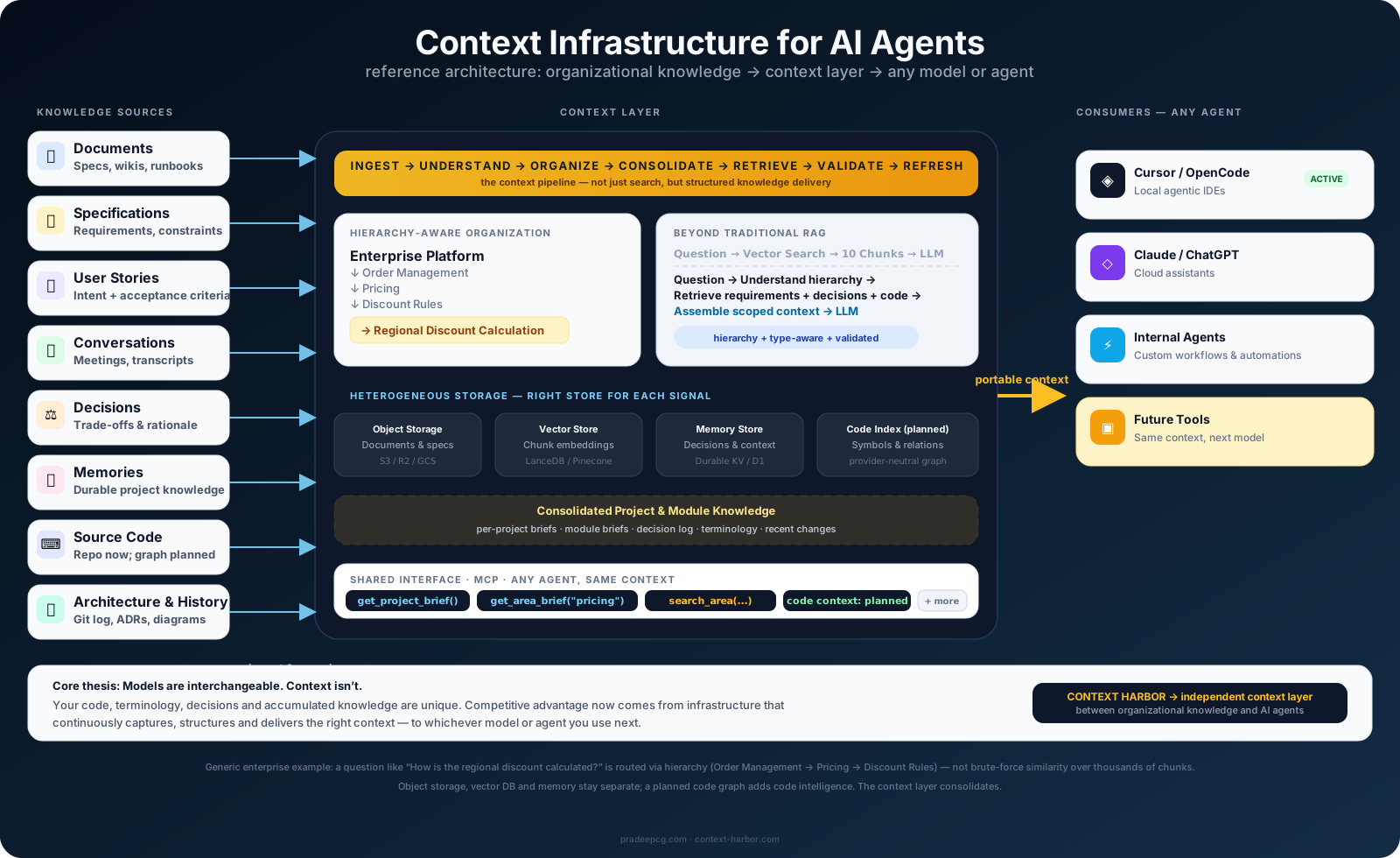
The right system does something different. It understands that the question belongs to Order Management → Pricing → Discount Rules, then scopes retrieval to that module: the pricing specification, the approved decision that fixed the regional formula, the consolidated module brief, and the code that implements the calculation.
That is not a better embedding. It is a better understanding of structure.
The shift: from retrieval to a context layer
This points to a broader architecture:
Documents ───────┐
Specifications ──┤
User Stories ────┤
Conversations ───┤
Decisions ───────┼──→  CONTEXT LAYER  ──→  AI Agents
Memories ────────┤
Source Code ─────┤
Git History ─────┤
Architecture ────┘
The context layer is not a database. It is a pipeline responsible for the full lifecycle of organizational knowledge:
Ingest → Understand → Organize → Consolidate → Retrieve → Validate → Refresh
- Ingest: capture knowledge where it already lives: docs, specs, user stories, transcripts, decisions, memories, code, commit history, and architecture records.
- Understand: extract structure by document type. A transcript yields decisions and action items. A spec yields requirements and constraints. A commit yields what changed and why.
- Organize: place knowledge in a project → module → sub-module hierarchy so retrieval is scoped, not scattered.
- Consolidate: build durable, human-readable briefs at the project and module level. An agent should not have to reconstruct the pricing module from thirty chunks on every question.
- Retrieve: blend signals appropriately: semantic intent, exact-term matching, document-type weighting, hierarchy filtering, and recency.
- Validate: check that retrieved context is authoritative, current, and sufficient before it reaches the model.
- Refresh: keep the layer current as documents, code, and decisions evolve.
When that layer exists, the model receives less text but better context. Answers become consistent because context delivery is systematic, not ad hoc.
The storage can be heterogeneous
An important architectural principle: the context layer does not mean "put everything in one vector database."
Different signals deserve different stores:
- Object storage for source documents and specifications
- Vector stores for searchable chunk embeddings
- Durable memory stores for decisions, terminology, and accumulated project knowledge
- Specialized code indexes for symbol relationships, dependencies, and implementation locality
- Consolidated knowledge for project and module briefs that agents can read directly
The power is not in centralizing bytes. It is in consolidating meaning and making it retrievable through a single, coherent interface regardless of where the bytes live.
One context, many agents
When context is infrastructure, it should not be rebuilt for every tool.
A team might use Cursor for feature work, OpenCode for agentic implementation and review, Claude or ChatGPT for analysis, and custom internal agents for automation. Each agent has a different harness. None should maintain its own private copy of organizational knowledge.
A shared interface solves this. Through MCP and similar contracts, every agent can consume the same context. Some operations already exist in ContextHarbor, while deeper code-context retrieval remains on the roadmap:
get_project_brief()
get_area_brief("pricing")
search_project_docs("regional discount calculation")
search_memory("pricing architecture")
# planned: code_context("discount calculation")
Cursor, OpenCode, Claude, ChatGPT, internal agents, and future tools therefore share one context infrastructure. Switch the model or change the agent, and the organizational knowledge moves with you.
That portability is the point.
Models are interchangeable. Context is not.
Model capabilities are improving rapidly. Strong models can write useful code and produce fluent answers, but switching models alone does not supply organizational context.
The gap between organizations is not.
Your code, your documentation, your decisions, your terminology, your conversations, and your accumulated knowledge are unique. No foundation model ships with them. No prompt can reliably reconstruct them at inference time.
An organization that treats context as infrastructure, continuously capturing, structuring, and delivering the right context to whichever model or agent is being used, builds a durable advantage. An organization that treats each agent as a separate silo rebuilds the same knowledge problem on every platform change.
The long-term competitive edge may therefore come less from choosing the "best" model and more from building the layer that makes any model understand your system.
Closing: where Context Harbor fits
This is the idea I have been exploring with Context Harbor: an independent context layer between organizational knowledge and AI agents that brings documents, memory, and project knowledge together while keeping that context portable across models and agent platforms.
Today, ContextHarbor connects documents, project-scoped memory, hierarchical knowledge, and retrieval tools through the same interface. Code Intelligence, including symbol relationships and impact analysis, is planned rather than shipped. The context layer can therefore grow without tying organizational knowledge to one model choice.
If the thesis is right that context, not model size, is the limiting factor, then the work ahead is infrastructure: ingest well, organize by hierarchy and document type, consolidate into durable briefs, retrieve with the right signals, and keep it fresh.
That is the foundation that lets AI agents move from plausible to reliable in enterprise environments.
If you are designing context infrastructure or an agentic workflow for your team and want to compare approaches, book a CTO consultation. You can also explore the product direction at context-harbor.com.